
Homeowners often focus on the eaves when they think about ice dams. But protecting your gutters and fascia from ice dams also means keeping the downspouts clear. These pipes carry water from the roof and gutters to the ground, so when they fill with ice during a cold Northern Utah winter, drainage can back up through the entire system.
When the downspouts freeze, the problem doesn’t just stay at the corners of the house. With nowhere to go, water can back up through the rest of the drainage system. From there, it can reach places you don’t want it, from beneath the shingles to ceilings and the foundation.
Why Downspouts Freeze First
Water in a downspout slows down at two distinct points. The first is the elbow at the top, where the pipe turns from the gutter trough and angles toward the side of the house. The second is the bottom section, where the pipe opens near the ground and is exposed to cold air.
At both spots, the water changes direction and loses speed. When it slows, the water is more likely to freeze, especially when the air around the downspout is below freezing. The elbow is especially vulnerable. It channels water through a tight bend, and any debris stuck there can collect water that quickly becomes ice. If the elbow or exit point freezes shut, the whole downspout is effectively sealed.
A frozen downspout can often happen without you noticing. Unlike an ice dam that you can sometimes spot along the roof’s edge, a downspout blockage sits out of sight inside a pipe. You might be able to check the exit point near the ground, but you may not see more than a few inches in.
What Backs Up When the Downspout Freezes
Once the downspout is blocked, the gutter has nowhere to send water. But that doesn’t stop meltwater from flowing. The gutter trough will keep taking in water until it overflows, causing water to spill over and run down the fascia, which is the board the gutters attach to. From there, excess meltwater will follow the wall toward the foundation.
Pooled water can also build up near the foundation, where it may melt and refreeze throughout the winter. Over time, that repeated freezing can add stress to concrete, walkways, and other surfaces around the home.
As water runs behind the fascia or down its surface, it can also create damage. Seeping water can soften or rot the wood, which shortens its lifespan. And weakened fascia may struggle to hold the gutters in place.
Why Frozen Downspouts Are Easy to Miss
Downspouts are easy to overlook because they usually do their job in the background. They sit at the end of the drainage system, away from the roofline where homeowners tend to look for ice. Even if you do inspect the downspout, you can’t see more than a few inches at its opening near the ground.
The visible signs of a plugged downspout tend to show up later and lower on the house. The most obvious is an unusual buildup of ice at the base of the downspout, but other symptoms include sheets of ice on the wall below the gutter or water stains on the fascia. Unfortunately, by the time those signs show up, your drainage system has been blocked for a while.
How Gutter Heat Tape Keeps Water Moving
A gutter heat tape installation provides warm surfaces along the full drainage path, including the exit point. This helps meltwater flow all the way from the roof to the ground instead of backing up in the trough or running down the fascia.
A heat tape installation that only covers the roofline leaves a key part of the drainage path unprotected. If heat tape doesn’t run through the downspout, ice can still block the exit point and back up the rest of the drainage system. The gutter may stay warm, but water that can’t exit the gutters and run down the downspout will still find somewhere to go.
Heat tape isn’t designed to cover the entire roof, so ice may still form above the treated areas. It’s important to have professional heat tape installers assess your roof before the first freeze to check for any additional problem spots.
What Proper Downspout Coverage Includes
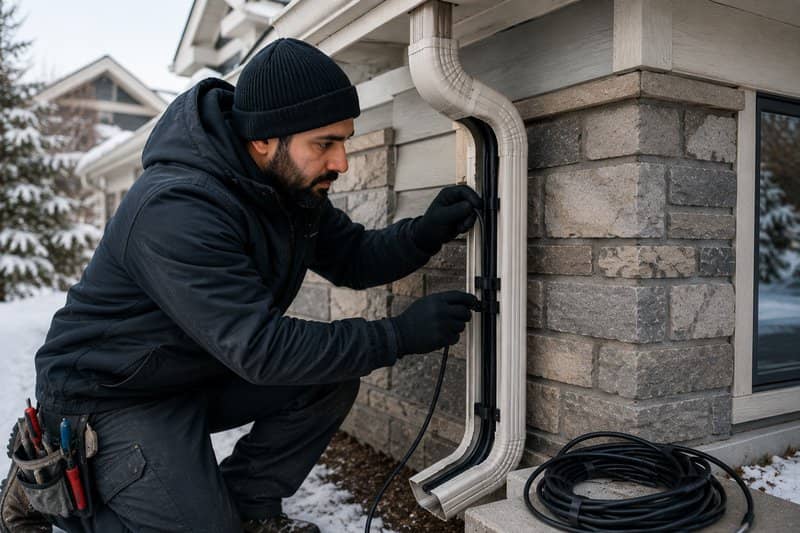
To run heat cable through a downspout effectively, an installer needs to understand how the full drainage system works. The cable needs to travel from the gutter through the elbow, run the full length of the pipe, and reach the outlet at the bottom. Cable guards give the cable another layer of protection at wear points where it presses against the pipe edge. Gutter separator clips keep it positioned correctly inside the trough before it enters the downspout.
Experienced heat tape installers plan for the gutters and downspout in a heat tape design from the start, not as an afterthought. Professionals use a self-regulating heat cable that adjusts its heat output based on surrounding conditions, making the system easy to manage all winter long.
The Exit Point Has to Work
The downspout doesn’t draw much attention until something goes wrong with it. But it’s an important exit point for your roof’s snowmelt in a Northern Utah winter. When the downspout gets blocked by ice, the whole gutter system backs up. A complete heat tape installation helps keep meltwater flowing from the roof to the ground, where it belongs.
If you live in Salt Lake City, or a community north of the city, now’s the time to gear up before the first freeze. A professional heat tape installer in Layton can assess your roof, gutters, and downspouts to ensure the entire drainage path is covered before winter hits.