
Does snowfall or cold weather have more of an impact on ice dams? Both matter, but the more useful question is simpler: which parts of your roof stay cold the longest?
Different sections of the same roof can accumulate and shed snow differently, especially in Northern Utah. One section may clear soon after a storm, while another may hold snow for days. And where snow accumulates and melts can affect where ice dams form.
It’s also the starting point for any roof heat cable installation plan.
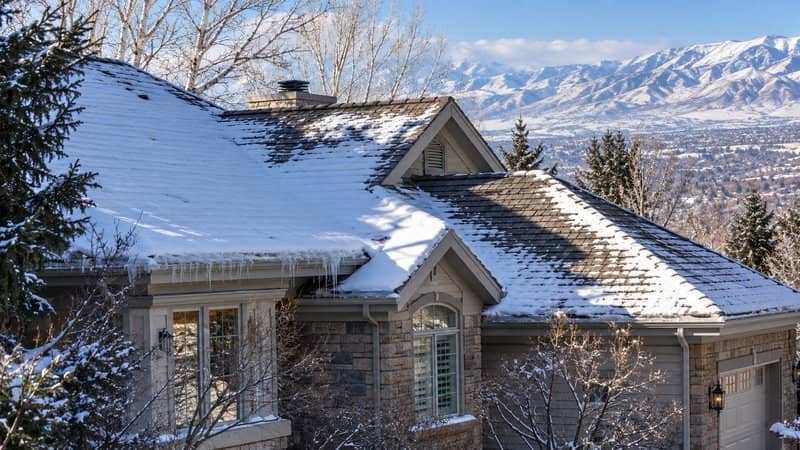
Roof Direction Influences Which Sections Stay Cold
In the winter, the sun stays low in the southern sky. Thus, a south-facing roof section may get hours of direct sun throughout the day. Snow on south-facing roof sections may clear faster.
Depending on the slope, a north-facing section may get little or no direct sun. Without direct sunlight, these roofing sections tend to stay colder, and snow can sit longer.
This difference is easiest to see from December through late January, when the days are short and the sun is low. A roof section that clears on its own in October may become a stubborn cold spot in the middle of winter.
The best way to check how long different roof sections retain snow is to watch your roof right after a storm. The spots that stay snowy are where ice dams are more likely to form.
Mature Trees Change the Shade Map
Bountiful has many older neighborhoods with mature trees, especially along the east bench. Some trees stand as tall as the roofline or higher.
That shade can change everything.
A south-facing roof section may behave like a north-facing one if a large evergreen blocks the winter sun. Deciduous trees lose their leaves, but their branches can still filter low winter light, making it less powerful.
Shade is also specific. A large tree casting shade can create different snow patterns on identical homes along the same side of the street.
That’s why heat tape installation in Bountiful shouldn’t be planned from the neighborhood level alone. The layout has to start with the roof itself, and needs to consider any sources of shade that affect it.
Hillside Shade Matters Too
On the east bench, the hillside itself can affect how snow melts. Homes may be built into the slope, with lower roof sections sitting below a taller part of the lot or beneath an uphill neighbor.
That kind of shade is different from tree shade. You can’t trim it back, and it changes with the calendar.
In December and January, the sun sits lower. A roof section that gets plenty of light in summer may sit in shadow through the coldest part of winter.
That’s why a summer walkaround won’t always show the full picture. It’s better to check for snowy patches after a storm. That will show you where shade keeps the snow from melting, even on an otherwise sunny side of the house.
Older Rooflines Can Add to the Problem
Many Bountiful bench homes were built decades ago. Some have lower roof pitches or attic insulation from another era. Both can affect how ice dams form.
A lower-pitched roof can hold snow longer. That gives the snow more time to melt and refreeze, which can lead to ice dams.
Older attic insulation can also let more household heat reach the roof deck. That warmth may melt the underside of the snow, even when the air outside is still cold. Water that runs down the roof and refreezes along a colder overhang risks creating ice dams.
Gutters can add to the problem. If meltwater refreezes inside a shaded gutter, that ice adds weight and blocks drainage. That extra weight can also strain fascia, which is the board the gutters attach to.
These factors can contribute to ice dams, but finding the source means looking at the roof pitch, attic insulation, gutters, and drainage path together. Identifying where the snow melts, where the water travels, and where it refreezes can help. That information can then guide you to the right approach to preventing ice dams.
Put the Heat Cable Where the Cold Is
North-facing and shaded eaves are often more likely to hold ice because they receive less direct sun. But on a mixed-exposure roof, snow can melt on sunny sections and refreeze when the meltwater reaches colder, shaded areas.
Heat cable should be installed along these problem areas to keep a drainage path open. Sunny sections may need less coverage if they consistently clear on their own.
The system should also follow the water from the roof into the gutters and downspouts. Meltwater that reaches an untreated gutter can still freeze and block drainage, even if the eave is heated. A complete layout should account for the full drainage path when planning roof and gutter ice dam prevention for homes.
The right placement depends on the roof’s exposure, snow accumulation, and drainage pattern. Identifying where snow lingers, where meltwater travels, and where it refreezes helps determine which areas need cable.
Map the Cold Sections Before Storms Arrive
Bountiful’s bench can bring lots of winter snow, but the real question is where that snow turns into ice. You can usually predict this before the first big storm by considering the direction of the roof sections and what might cast shadows nearby.
Experienced heat cable installers start with the individual roof rather than a one-size-fits-all layout. Our team at Lion Flow begins each heat cable installation in Bountiful by mapping the sections that stay cold and matching the cable and hardware to those areas. Planning before winter also gives the installer time to place the cable correctly while the roof is still clear.